
Juke Box - Episode 7
A personal favorite: Duke Ellington's "Black, Brown And Beige!"

Today the Mighty Wurlitzer spins a legendary jazz recording: Duke Ellington’s 1943 suite Black, Brown and Beige.
Hello again and welcome to another installment of Ol’ Doc’s Juke Box.
Being a former FM radio jazz DJ and professional church singer, my musical interests are many and varied. This is my sub-Stack for sharing music both close to my heart and worthy of your time.
Feel free to leave a comment, including suggestions for future episodes.
Being a former jazz DJ, my appreciation of the genre spans its entire history: from its origins in New Orleans jass, through the Big Band era of the 1920s — 40s, the bebop of the 50s and 60s, to the fusion of the 70s and beyond.
I am pleased to report that I had the pleasure of playing Black, Brown and Beige on my radio show on the Centennial of Ellington’s birth, April 29, 1999.
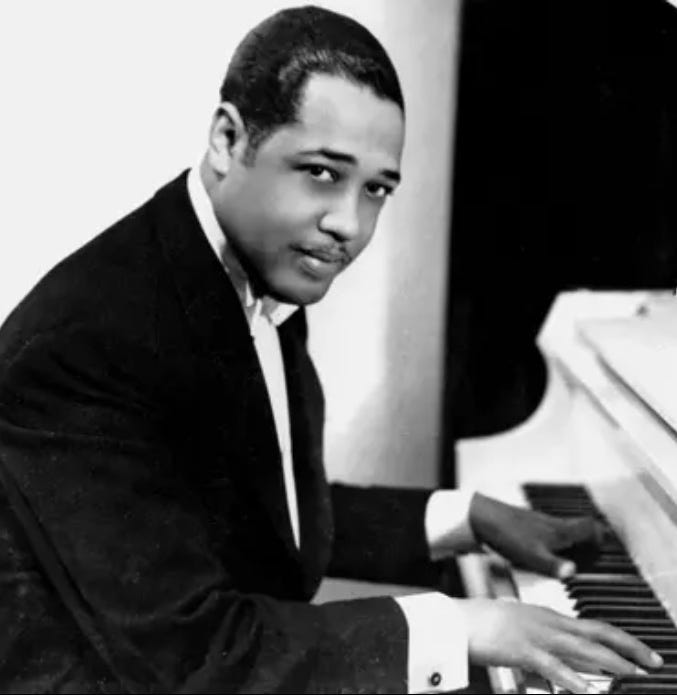
From almost the very beginning, Edward Kennedy ‘Duke’ Ellington was central to the development of the African-American music which PopCultureLLC insisted upon labeling jazz. He began his career as a pianist, playing at social events and in dance halls; due to his charismatic personality and musical skill he eventually became a bandleader, moving to New York City in 1923, where he enjoyed great success.
From wikipedia:
Abandoning the conventions of swing, he experimented with orchestral sounds, harmonies and musical forms, [creating] complex compositions that still translated well for popular audiences; many of his tunes became hits, and his popularity spread from the United States to Europe.
Ellington called his music American Music, rather than jazz; and liked to describe musicians who impressed him as "beyond category." These included many musicians from his own band, some of whom are considered among the best in jazz in their own right; but it was Ellington who melded them into one of the most popular orchestras in the history of jazz.
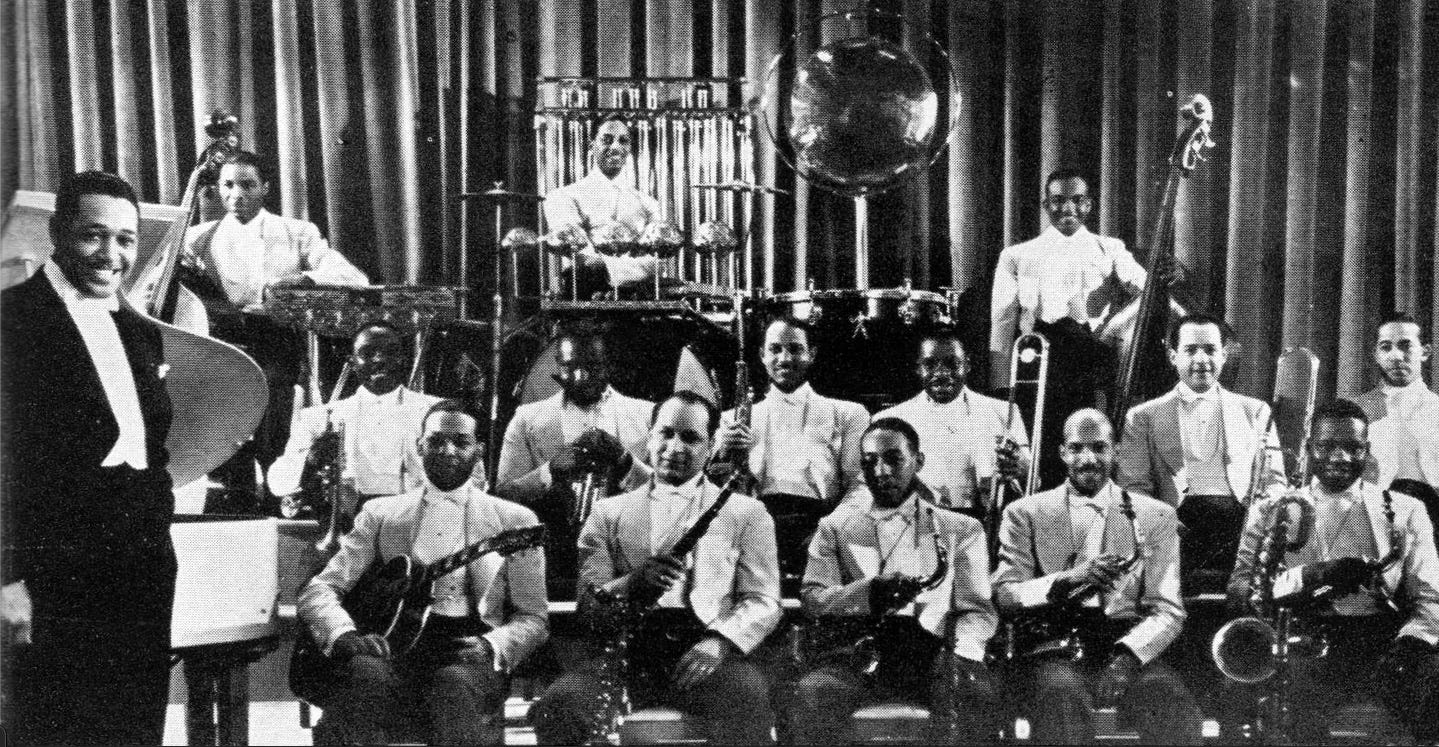
The band’s reputation skyrocketed due to weekly national live radio broadcasts from Harlem’s Cotton Club, where Ellington wrote music to accompany the stage shows. But his ambitions to expand the genre beyond dance music — and the 3-minute time-limit of the 78 RPM record — were ever-present:
The British visit saw Ellington win praise from members of the serious music community, including composer Constant Lambert, which gave a boost to Ellington's interest in composing longer works.
His longer pieces had already begun to appear. Ellington had composed and recorded "Creole Rhapsody" as early as 1931 (issued as both sides of a 12" record for Victor and both sides of a 10" record for Brunswick). A tribute to his mother, "Reminiscing in Tempo," took four 10" 78 RPM record sides to record in 1935 after her death that year. Symphony in Black, a short film, featured his extended piece 'A Rhapsody of Negro Life.' It introduced Billie Holiday, and won the 1935 Academy Award for Best Musical Short Subject.
Symphony in Black represents a landmark in musical, cultural and entertainment history, as well as significant progress in Ellington’s own biography. It is a member of the first generation of non-classically-arranged orchestral scores and, perhaps most importantly, one of the first film scores written by an African-American describing African-American life to reach wide distribution…while Symphony in Black is the title of the Paramount film, A Rhapsody of Negro Life is the actual title of Ellington's composition. The piece has been largely overshadowed by its successor, perhaps Ellington’s best-known extended composition, Black, Brown, and Beige, and thus significantly less documentation exists concerning it…
Thus, Black, Brown and Beige was not Ellington’s first try at extended-form composition:
Ellington's long-term aim, though, was to expand the jazz form past that three-minute [78 RPM record] limit, of which he was already an acknowledged master. While he had composed and recorded some extended pieces previously, such works now became a regular feature of Ellington's output. In this, he was helped by [his protégé] Billy Strayhorn, who had a more thorough training in the forms associated with classical music than Ellington.
The first of these, Black, Brown, and Beige (1943), was dedicated to telling the story of African-Americans, and the place of slavery and the Church in their history. Black, Brown and Beige debuted at Carnegie Hall on January 23, 1943, beginning an annual series of Ellington concerts at the venue over the next four years. While jazz musicians had played at Carnegie Hall before him, none had performed anything as elaborate as Ellington's work.
It tells the history of African-Americans, and was the composer's attempt to transform attitudes about race; elevate American music (specifically, jazz) to be seen as on par with classical European music; and to challenge America to live up to its founding principles of freedom and equality for all.
Black, the first movement, is divided into three parts: the Work Song; the spiritual Come Sunday; and Light.
Brown also has three parts: West Indian Influence (or West Indian Dance); Emancipation Celebration; and The Blues.
Beige depicts the African-Americans of the post-World War I era.
Ellington introduced the piece onstage at Carnegie Hall as "a parallel to the history of the Negro in America." In writing Black, Brown and Beige, Ellington endeavored to create a Jazz composition as sweeping as any Classical work, with the following bold statement:
"...unhampered by any musical form, in which I intend to protray the experiences of the colored races in America in the syncopated idiom...I am putting all I have learned into it, in the hope that I shall have achieved something really worthwhile in the literature of music; and that an authentic record of my race, written by a member of it, shall be placed on record.
We thought we wouldn't play it in its entirety tonight, because it represents an awfully-long and important story; and I don't think too many people are familiar with the story. This is the one we dedicate to the 700 Negroes who came from Haiti to save Savannah during the Revolutionary War."
There are several choices for listening to Black, Brown and Beige:
The Duke Ellington Carnegie Hall Concerts: January 1943 (Prestige Records) - a recording of the January 23, 1943 Carnegie Hall premiere
Black, Brown and Beige (RCA Records, 1988 compilation) - includes 1943 excerpts, the first re-released instances of Black, Brown and Beige segments available on modern commercial recordings
Black, Brown and Beige (Columbia Records, 1958 release) - a partial, ("Black" only) reworked suite, with Mahalia Jackson on vocal
The Private Collection, Vol. 10: Studio Sessions New York & Chicago, 1965, 1966 & 1971 (LMR Records, 1987 release) - Ellington’s privately-recorded revision of the three-movement piece into a nine-part work, and the most complete studio version of the suite.
Black, Brown and Beige (Blue Engine Records, 2020 release) - a live performance of the complete original suite recorded by the Jazz at Lincoln Center Orchestra in 2018
I have chosen to go with the original Carnegie Hall recording, although they each have their merits and deserve a listen if you are so inclined.
The Duke Ellington Carnegie Hall Concert, January 1943 1
Note that Tracks 13, 14 and 15 comprise the Black, Brown and Beige suite, approximately 50 minutes long, if you’d care to ‘cut to the chase.’
Note also that in 1943 (during World War II), live-concert-recording technology was primitive, and the resulting sound quality is poor compared with what today’s ears are used to. Best results on my setup require the following equalization:

I hope you enjoy today’s selection, and TYVM for listening.
To enjoy YT videos without the ads, install browser extension uBlock Origin